


Industry News
Researchers Develop World's Thinnest Lens Using Quantum Effects
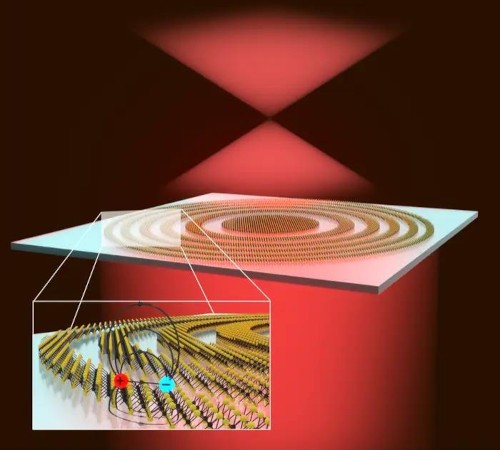 Researchers from the University of Amsterdam and Stanford University have created the thinnest lens on Earth, measuring just 0.6 nanometres thick - about the width of three atoms. This breakthrough lens is made of a single layer of tungsten disulphide (WS2) and uses quantum effects to efficiently focus light.
Unlike traditional curved glass lenses that rely on refraction, this flat "Fresnel lens" or "zone plate lens" focuses light through diffraction. The size and spacing of the concentric rings of WS2 material determine the lens's focal length, which in this case is 1 mm for red light.
A key advantage of this lens is that it harnesses quantum effects within the WS2 material to enhance its efficiency. When WS2 absorbs light, it creates "excitons" - bound pairs of electrons and electron holes. These excitons then quickly re-emit light, contributing to the lens's ability to focus light.
"The scientists detected a clear peak in lens efficiency for the specific wavelengths of light sent out by the excitons," the article states. "While the effect is already observed at room temperature, the lenses are even more efficient when cooled down. This is because excitons do their work better at lower temperatures."
Another unique feature is that most of the light passes through the lens unaffected, while a small portion is focused. This makes the lens well-suited for applications like augmented reality glasses, where the user's view should not be obstructed.
"The lens can be used in applications where the view through the lens should not be disturbed, but a small part of the light can be tapped to collect information. This makes it perfect for wearable glasses such as for augmented reality," explains Jorik van de Groep, one of the authors.
The researchers are now exploring ways to electrically control the lens's refractive index by manipulating the excitons, opening up possibilities for more complex and reconfigurable optical devices.
This breakthrough in ultra-thin, quantum-enhanced optics could have significant implications for future wearable technologies, imaging systems, and other applications requiring compact, high-performance optical components.
The researchers reported on their work in the scientific journal Nano Letters