


Vabysmo Added To PBS listing For Treatment of nAMD and DMO
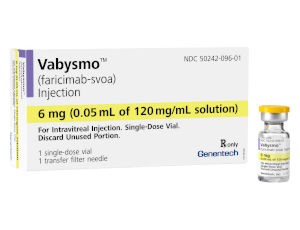 The Pharmaceutical Benefits Advisory Committee (PBAC) recommended the Authority Required listing of Roche’s Vabysmo (faricimab) for the treatment of nAMD and diabetic macular oedema (DMO) at its meeting in May 2022.
The PBAC’s recommendation for listing the treatment of nAMD was based on, among other matters, its assessment that the cost-effectiveness of faricimab would be acceptable if it were cost-minimised to PBS-listed anti-VEGF treatments such as aflibercept and ranibizumab for the same indication. The PBAC supported a 2-year time horizon for the cost-minimisation calculation, and considered the equi-effective doses for the treatment of nAMD to be:
- Year 1: 7.20 doses of faricimab annually to 7.69 doses of aflibercept 2 mg annually
- Year 2: 4.30 doses of faricimab annually to 6.31 doses of aflibercept 2 mg annually.
The new two-year data from the TENAYA and LUCERNE studies reinforce the long-term efficacy, safety and durability of Vabysmo® (faricimab) in neovascular or “wet” age-related macular degeneration (nAMD), a leading cause of vision loss. Neovascular AMD affects nearly 20 million people globally and can require treatment with eye injections every one to two months. The two-year data were presented at the 2022 American Society of Retina Specialists Annual Scientific Meeting on 14 July.
“These longer-term results reinforce confidence in Vabysmo and support its continued use in people with neovascular AMD,” said Levi Garraway, M.D., Ph.D., Chief Medical Officer and Head of Global Product Development at Roche. “With the potential to require fewer injections over time, Vabysmo continues to represent an important step forward for people with vision-threatening retinal conditions, and these data exemplify our commitment to redefining standards of care and reducing treatment burden.”
In the TENAYA and LUCERNE studies, at two years:
- More than 60% of people receiving Vabysmo could be treated every four months – an increase of over 15 percentage points since the primary analysis at one year – while achieving comparable vision gains versus aflibercept given every two months.
- Nearly 80% of people receiving Vabysmo could be treated every three months or longer.
- Patients treated with Vabysmo received a median number of 10 injections over the two years versus 15 injections for those patients treated with aflibercept, potentially decreasing the number of injections.
- Comparable reductions in central subfield thickness (CST) were observed with Vabysmo given at intervals of up to four months versus aflibercept given every two months.
- No new safety signals were identified and Vabysmo continued to be well tolerated, with a favourable benefit-risk profile.
For the treatment of diabetic macular oedema the PBAC supported a 2-year time horizon for the cost-minimisation calculation, and considered the equi-effective doses to be:
- Year 1: 8.23 doses of faricimab annually to 6.38 doses of aflibercept 2 mg annually
- Year 2: 4.68 doses of faricimab annually to 5.27 doses of aflibercept 2 mg annually.