


Australian Researchers Produce Breakthrough Tiny Device That Mirrors Human Vision and Memory Abilities
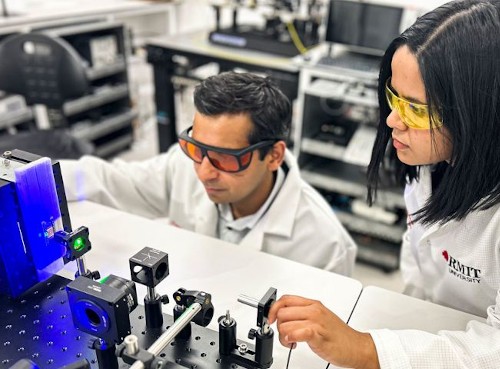 Scientists have achieved a major breakthrough by creating a compact device that closely imitates human vision and memory functions, opening doors to applications that require swift and intricate decision-making, such as self-driving cars. This remarkable neuromorphic invention, powered by a sensing element called doped indium oxide, operates as a single chip with a thickness thousands of times thinner than a human hair and operates independently without the need for external components.
The leading researchers from RMIT University collaborated with experts from Deakin University and the University of Melbourne to develop this groundbreaking device. Their research showcases a fully functional prototype capable of capturing, processing, and storing visual information. By precisely engineering the doped indium oxide, the device emulates the human eye's ability to perceive light, process and transmit information akin to an optical nerve, and store and categorize data in a memory system resembling the human brain.
This confluence of functionalities holds the potential for ultra-fast decision-making, according to the team. Professor Sumeet Walia, the project leader from the School of Engineering, emphasized that the device performs all necessary functions—sensing, information generation and processing, and memory retention—eliminating the need for energy-intensive external computation that hampers real-time decision-making.
Walia explained, "Until now, it has been a significant challenge to achieve all these functions on a single small device. Our invention makes real-time decision-making feasible since it doesn't have to process large volumes of irrelevant data or encounter delays from transferring data to separate processors."
The novel device exhibits superior memory retention compared to previous models without the requirement for frequent electrical signals to refresh the memory. This breakthrough reduces energy consumption significantly while enhancing overall performance.
Aishani Mazumder, the study's first author and a PhD researcher at RMIT, highlighted the advantages of analog processing used by the human brain. This approach enables quick and energy-efficient information processing, unlike the energy-intensive digital processing that hinders swift data gathering and analysis. Mazumder emphasized that neuromorphic vision systems, which employ analog processing akin to the human brain, require significantly less energy for complex visual tasks compared to existing technologies.
During their experiments, the researchers employed ultraviolet light and plan to expand the technology further to include visible and infrared light. The potential applications are diverse, ranging from bionic vision and autonomous operations in hazardous environments to shelf-life assessments of food and advanced forensics.
Walia envisioned the possibilities, stating, "Imagine a self-driving car that can perceive and identify objects on the road just like a human driver, or the ability to rapidly detect and track space debris. These feats can be accomplished with neuromorphic vision technology."
Moreover, Walia highlighted that neuromorphic systems can adapt and become more efficient over time, enabling them to respond to new situations. Traditional computer vision systems, in contrast, lack this adaptability since they rely on specific pre-programmed rules and lack the flexibility to adjust easily.
"The potential for neuromorphic robots to operate autonomously for extended periods, especially in dangerous environments where workers may face cave-ins, explosions, and toxic air, is remarkable," Walia added.
Unlike conventional cameras and computers with multiple components, the human eye has a single retina that captures complete images, which are then processed by the brain to identify objects, colors, and other visual features. The team's device emulates the retina's capabilities using single-element image sensors that capture, store, and process visual information on a unified platform.
"The human eye excels at swiftly responding to changes in the environment, far more efficiently than current cameras and computers. Inspired by the eye, we have been working for several years on developing a camera with similar capabilities through the field of neuromorphic engineering," Walia explained.
The team's findings have been published in the prestigious journal Advanced Functional Materials.