


Immersive VR Goggles for Mice Unlock New Potential
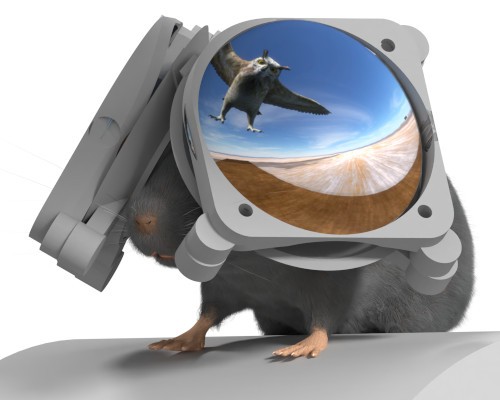 Researchers at Northwestern University have unveiled groundbreaking Virtual Reality (VR) goggles designed specifically for mice, marking a significant leap forward in the study of neural circuitry and behavior in laboratory settings. The miniature goggles aim to provide more immersive experiences for mice by faithfully simulating natural environments, allowing for more accurate and precise research.
In contrast to existing systems that utilise computer or projection screens, the newly developed VR goggles eliminate the limitations associated with traditional setups. Unlike flat screens that cannot convey three-dimensional (3D) depth, the new goggles offer a comprehensive and immersive experience for the mice, addressing challenges related to the visibility of the lab environment and the inability to simulate overhead threats.
Published on December 8 in the journal Neuron, the research led by Northwestern's Daniel Dombeck introduces the use of a VR system to simulate overhead threats for the first time.
"For the past 15 years, we have been using VR systems for mice," explained Daniel Dombeck, a professor of neurobiology at Northwestern’s Weinberg College of Arts and Sciences and the senior author of the study. "Now think about putting on VR goggles, like Oculus Rift, that take up your full vision. You don’t see anything but the projected scene, and a different scene is projected into each eye to create depth information. That’s been missing for mice."
The newly developed VR goggles, named Miniature Rodent Stereo Illumination VR (iMRSIV), utilize custom-designed lenses and miniature organic light-emitting diode (OLED) displays to offer a 180-degree field of view for each eye, fully immersing the mice and excluding the surrounding environment. Unlike conventional VR goggles for humans, the iMRSIV system does not wrap around the mouse's head but is closely attached to the experimental setup, providing a unique solution for studying neural activity.
The research team, leveraging recent advances in hardware miniaturization, achieved reduced training times for mice using the iMRSIV system. Mice wearing the goggles demonstrated quicker engagement with virtual environments compared to those using traditional VR systems.
Additionally, the researchers successfully simulated overhead threats, a feat previously impossible with current systems. By projecting a dark, expanding disk into the top of the goggles, the team triggered common responses in mice, such as increased speed or freezing, shedding light on the neural activity associated with these behaviors.
The breakthrough not only opens new avenues for research but also enhances accessibility to neurobiology studies. Daniel Dombeck expressed hope that the relatively inexpensive and user-friendly nature of the goggles would make VR technology more accessible to other research labs, potentially revolutionizing the field.
"As VR grows in popularity, the goggles also could help researchers glean new insights into how the human brain adapts and reacts to repeated VR exposure — an area that is currently little understood," the researchers concluded.