

Researchers Secure Grant to Pioneer AI-Powered Oculomics Device
 Scientists at Indiana University (IU) specialising in optometry and artificial intelligence are breaking new ground in the emerging field of “oculomics,” which uses the eye as a lens on diseases that affect the whole body. The research is granted a US$4.8 million award from the US National Institutes of Health (NIH) Venture Program Oculomics Initiative. This innovative program supports research into using the eye as a diagnostic tool to detect systemic diseases.
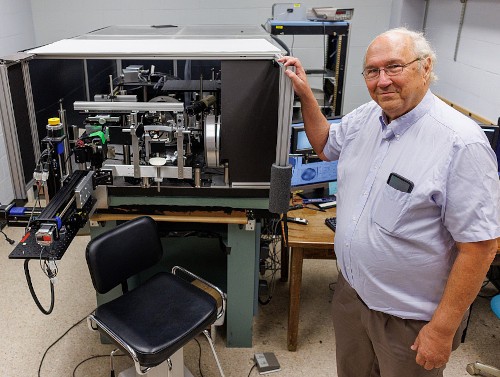
The IU-led research team, spearheaded by Stephen A. Burns, professor at the IU School of Optometry, and co-investigator Eleftherios Garyfallidis, associate professor of intelligent systems engineering at the Luddy School of Informatics, Computing, and Engineering, will develop next-generation ophthalmoscopes capable of detecting early signs of diseases such as diabetes, heart disease, Alzheimer’s, and more, through non-invasive eye scans.
“This research is about using the eye as a window on health,” said Burns, emphasizing the retina’s role as the only directly observable part of the central nervous system. The technology being developed could revolutionise diagnostic capabilities, allowing healthcare providers to identify warning signs of serious conditions without invasive procedures.
The project involves collaboration with co-investigators from top institutions, including Amani Fawzi of Northwestern University, Alfredo Dubra of Stanford University, and Toco Y. P. Chui from the New York Eye and Ear Infirmary of Mount Sinai. Together, these researchers will combine their expertise and state-of-the-art machine learning methods to create a singular, powerful diagnostic device.
Garyfallidis’ team will focus on integrating artificial intelligence to interpret scan results, which could significantly reduce diagnosis times, transforming a process that typically takes days into just minutes.
In its first year, the project will concentrate on aligning different instruments to the same sensitivity level, followed by validation tests comparing AI-generated diagnoses with human experts. By the final phase, the team plans to test the device on clinical volunteers, with data collected from patients at IU’s Atwater Eye Care Center.
Burns is optimistic about the potential for wide-reaching impact: "Up to 80% of the population over 60 has at least one detectable health issue using this technology. Our goal is to bring this from the lab to routine eye exams."
The NIH recognised the project for its potential to accelerate scientific discovery with modest, high-impact investments. If successful, this breakthrough could transform regular eye exams into a powerful diagnostic tool for monitoring overall health.
(Photo by Chris Meyer, Indiana University)