


Specsavers and Cascader Join Forces in AI Push to Tackle Looming Eye Health Crisis
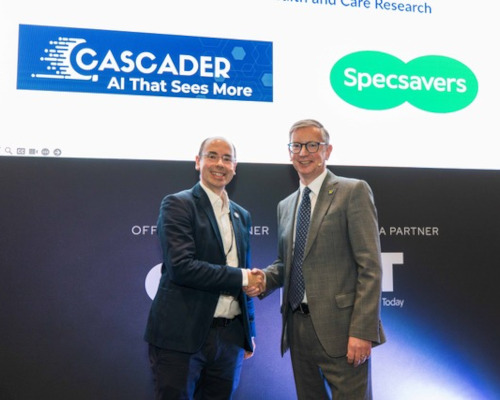 A new partnership between Specsavers and UK medical AI company Cascader is set to reshape how artificial intelligence is deployed in community optometry.
Specsavers has announced a collaboration with Cascader, a medical technology firm whose AI capabilities are built on foundational research conducted at London's world-renowned Moorfields Eye Hospital and University College London. The partnership is focused on identifying the most clinically effective and scalable ways to embed AI tools into everyday optometric practice.
For Australian eyecare professionals, the announcement carries particular weight. Specsavers is one of the most significant players in the local market, and the company has made clear that the ambition extends globally with Specsavers' clinical services director Giles Edmonds explicitly stating the goal is to "transform pathways of care for patients not just in the UK but across the whole of the globe."
AI as a clinical partner, not a replacement
A key message from both parties is that the technology is firmly positioned as decision-support rather than a substitute for clinical judgement. Mike Horler, Cascader's optometric advisor, was direct on the point: the optometrist remains the primary decision-maker, with AI serving to streamline complex data analysis, reinforce diagnostic confidence, and reduce error.
"AI is evolving into a powerful clinical partner that augments a practitioner's existing skills," Horler said. "It provides a safety net that enhances diagnostic confidence, reduces errors, and allows optometrists to deliver better patient-centred care."
It's a framing that will likely resonate with practitioners wary of overreach, reassurance that the technology is designed to support the consultation room, not bypass it.
Taking on the glaucoma tsunami
The clinical backdrop to the partnership is urgent. Edmonds pointed to the so-called "glaucoma tsunami", a projected surge in glaucoma cases driven by an ageing global population, as one of the core eye health challenges the sector must urgently address. For a country like Australia, where, according to Glaucoma Australia, an estimated 300,000 people are living with glaucoma and half remain undiagnosed, that framing lands close to home.
Cascader CEO and ophthalmologist Peter Thomas said the partnership is geared toward unlocking AI's potential for "earlier detection, screening and proactive management driven by systemic health insights from optometry consultations, images and data." Working with Specsavers at scale, he added, is key to understanding how to deploy that capability broadly.
Breaking down barriers to adoption
Paul Morris, Specsavers' director of professional advancement, noted the partnership has a specific focus on dismantling barriers to implementation ensuring that AI tools don't remain confined to hospital ophthalmology departments but reach the community setting where the bulk of eye health encounters actually occur.
That's a critical point for independent and franchise optometrists alike. The real-world challenge has never been the technology in isolation. It's been integration into busy clinical workflows, practitioner confidence, regulatory considerations, and equitable access. Whether this partnership yields tools that genuinely translate into the community optometry context will be the metric that matters.
The collaboration is still in its exploratory phase, with both organisations working to determine optimal deployment strategies before any broader rollout. But with Specsavers' scale and Cascader's research pedigree, the industry will be watching closely to see what emerges.