
Smartphone Refractive Screening Goes 2.0 and It's Coming for Kids Too
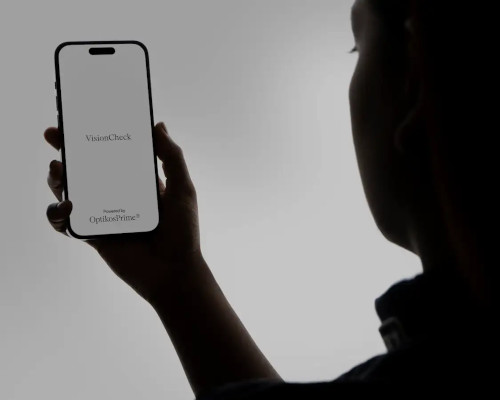 OptikosPrime launches a major update to its VisionCheck app alongside clinical evidence supporting its use in paediatric populations
Danish healthtech company OptikosPrime has rolled out VisionCheck 2.0, a significant upgrade to its smartphone-based refractive screening tool, while simultaneously publishing clinical data validating its performance in children under 12. For eye care professionals considering scalable screening solutions whether in practice, school programs, or community outreach the dual announcement marks a meaningful step forward.
What's new in 2.0
Until now, VisionCheck was built for one thing: fast, accessible screening from a single phone photo. With 2.0, the company says it is beginning to build continuity.
The headline addition is user accounts, which unlock what OptikosPrime describes as an ongoing awareness layer. Users can now access previous measurements, track how their eyesight changes over time, and store prescriptions from optician visits. For practitioners, this longitudinal data trail could prove useful for patients who are monitoring progressive myopia or post-surgical recovery.
Profile support has also been introduced, allowing users to create and manage measurements for family members or friends opening up new use cases in both households and screening environments.
A short pre-test symptom questionnaire has been added to strengthen the clinical picture. Before each test, the app now asks three questions: whether the user frequently experiences headaches, whether they can see clearly at distance, and whether they can see nearby objects or text clearly.
OptikosPrime launches a major update to its VisionCheck app alongside clinical evidence supporting its use in paediatric populationsOn the privacy side, users can now update contact details directly in the app, revoke GDPR consent without needing to contact support, and manage or delete their own data. Given the sensitivity of health data in paediatric screening contexts, this is a notable inclusion.
The update also brings a redesigned interface with updated fonts, colours, and a cleaner, more intuitive layout. The app is currently optimised for the iPhone 15 Pro and 16 Pro series, with expanded device support rolling out progressively.
The paediatric case: clinical evidence and physiological insight
Alongside the product update, OptikosPrime published a technical write-up presenting evidence for VisionCheck's performance in children, a population where traditional screening tools often fall short.
Uncorrected refractive error remains one of the most common and treatable causes of reduced vision in children worldwide, and delayed detection can affect neurovisual development, school performance, and quality of life. In early childhood, missed refractive error can increase the risk of amblyopia during the period when treatment is most effective.
The company's clinical data comes from two sources. A prospective study conducted with Aarhus Ophthalmology Centre in Denmark tested VisionCheck on 18 children aged 12 and under. VisionCheck produced 16 correct predictions out of 18 cases, corresponding to 88.9% classification accuracy consistent with the expected model behaviour observed in prior validation studies of approximately 90%.
A larger retrospective analysis using OptikosPrime's ProApp dataset which includes age metadata collected by practising opticians found that VisionCheck achieved 85.1% accuracy and a weighted F1 score of 85.3% on the conclusive paediatric subset (children under 15).
Intriguingly, the company also identified a physiological advantage in screening children. Analysis of their pupil–iris segmentation model found that paediatric eyes showed consistently larger pupil diameters than adults, with a median difference of +0.69 mm. Larger pupil apertures increase the visibility of refractive signals under standard capture conditions, which the team says may explain the tool's strong paediatric performance.
Implications for the profession
For Australian eye care practitioners, the most immediately relevant implication of VisionCheck 2.0 is arguably its potential role in non-clinical screening. Because VisionCheck requires no optical training, non-clinical staff such as school nurses, teachers, or community health workers can perform preliminary vision screening consistently and objectively, expanding the reach of early detection efforts and helping identify children who need full clinical evaluation.
That positions the tool not as a replacement for a clinical refraction, but as a referral pipeline for practices particularly those involved in school screening programs, Indigenous community outreach, or rural and regional vision initiatives where access to specialist equipment remains limited.
Professor Tony Pansell of Karolinska Institutet, who is cited in the research, put it plainly: a tool capable of delivering objective, repeatable refractive-error screening using only a smartphone "has the potential to transform early detection" in communities where trained eye care personnel are in short supply.
VisionCheck 2.0 is available now on the App Store. OptikosPrime is offering briefings for clinical teams interested in evaluating the tool for paediatric or population screening workflows.