

Smart Contact Lens Could Transform Glaucoma Management With Real-Time Monitoring and Automated Drug Delivery
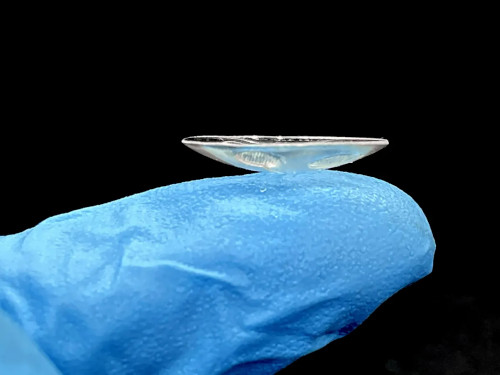 Researchers in the United States have developed an electronics-free smart contact lens capable of continuously measuring intraocular pressure and automatically dispensing medication, a breakthrough that could fundamentally change how eyecare practitioners manage glaucoma.
The device, developed by Dr. Yangzhi Zhu and colleagues at the Terasaki Institute for Biomedical Innovation (TIBI) in Los Angeles, was published on 8 April 2026 in Science Translational Medicine. It represents a significant step toward closing the loop between disease monitoring and treatment all within a single, wearable platform worn directly on the eye.
Glaucoma remains one of the most pressing public health challenges in eyecare. More than 80 million people are affected globally, making it the second most common cause of blindness worldwide. Progression of the disease is linked to elevated intraocular pressure (IOP) damaging the optic nerve, and while the condition is incurable, it can be managed pharmacologically. The challenge, however, is that management is inconsistent. The gold-standard approach for measuring eye pressure requires patients to visit a clinic, with checkups often months apart, providing only infrequent snapshots that frequently fail to capture the true dynamics of the disease. Compounding this, prior research has found that nearly half of patients discontinued treatment within six months of filling an initial prescription.
Dr. Zhu's team set out to address both problems simultaneously. The all-polymer lens incorporates a microfluidic sensor that monitors IOP, as well as pressure-activated drug reservoirs that dispense medication as eye pressure rises with no electronic components required.
"A lot of patients forget to take the medicine at the right time," said Dr. Zhu. "For our technology, we don't need the user to manually operate or trigger. Everything is based on the sensor and the closed-loop drug delivery."
How the Lens Works
The lens's mechanics are elegantly simple. Using 3D-printed moulds, the researchers embedded tiny microchannels and reservoirs into the bottom layer of the contact lens, which were then filled with a specially designed silk sponge capable of absorbing up to 2,700 times its weight in fluid.
One reservoir contains a red fluid for pressure measurement. When eyeball pressure rises, it compresses the reservoir enough to push the red liquid further along a snaking microchannel. A smartphone imaging app using a convolutional neural network trained on images of these microchannels in varying states can then provide a pressure readout with 94 per cent accuracy.
Drug delivery operates on a similarly mechanical principle. Two drug-filled reservoirs are connected to microchannels delivering medication to the ocular surface. As IOP rises, the reservoir is compressed and the drug is pushed through the channels with the threshold adjustable by varying the width of the channel, making it possible to tune delivery and even administer two different drugs at different pressure levels.
The prototype can hold sufficient medication for up to two weeks of use. The narrow microchannel design means the sensor and drug release mechanism respond only to the sustained pressure buildup characteristic of glaucoma, rather than short, sharp spikes caused by actions like blinking or swallowing.
Why Go Electronics-Free?
Previous attempts at smart contact lenses for glaucoma have relied on embedded electronics. In 2016, the US Food and Drug Administration approved a device called Triggerfish, which embeds electronic components into a lens for continuous IOP monitoring. However, Dr. Zhu's group deliberately moved away from this approach. "Frankly speaking, we know that electronic control is the most accurate, but the issue is that it is not user-friendly and not biocompatible, or comfortable for long-term use," he said. "So we needed to find a better balance between accuracy and user comfort."
Independent commentary from Professor Chi Hwan Lee, a biomedical and mechanical engineering researcher at Purdue University, largely validates this rationale. He described the device as "an elegant solution for combining pressure sensing and drug delivery while avoiding the comfort and safety concerns associated with the use of electronic components," noting these were "important considerations for long-term wear and real-world adoption, particularly in a chronic condition such as glaucoma."
Professor Lee did, however, flag one notable limitation: because pressure readings require the user to hold a smartphone up to their eye, monitoring is not truly continuous, a significant constraint given that glaucoma often involves clinically relevant IOP fluctuations outside of waking hours that this system would miss. He suggested the technology would be most valuable as a complement to electronic approaches rather than a wholesale replacement: "When used alongside electronic systems, they could offer a synergistic strategy — providing a simpler, low-cost, and potentially more comfortable option for intermittent or threshold-based monitoring and therapy, while electronic devices deliver continuous, high-resolution data."
Preclinical Results and the Road to Clinic
In animal testing, the results were encouraging. In rabbits, the team demonstrated that closed-loop drug delivery via the smart contact lens was as effective as conventional eye drop treatment, while also enabling accurate IOP monitoring. No inflammation or biocompatibility issues were recorded over 14 days of repeated use.
For practitioners, a key point of interest is manufacturability. Dr. Zhu noted that the fabrication process is already well aligned with existing contact lens manufacturing approaches, and all information needed to personalise lenses for individual patients could be gathered during the standard contact lens fitting process.
His team is already working toward commercialisation and has applied for a provisional patent. And while the initial focus is glaucoma, the ambitions for the platform are broader. Dr. Zhu believes it could ultimately be extended to a range of ocular conditions including dry eye, diabetic retinopathy, and age-related macular degeneration.