


PNG Ophthalmologist Dr Jambi Garap Named Inaugural Recipient of Gabi Hollows Award
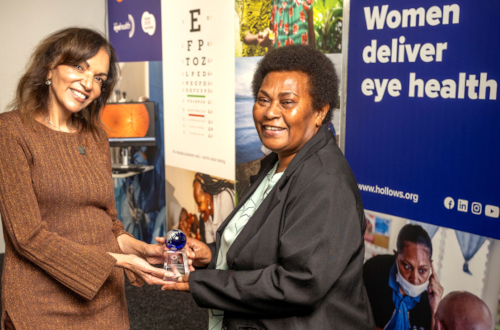 The Fred Hollows Foundation honours a Pacific trailblazer whose decades of leadership have transformed eye health systems in one of the world's most challenging environments
Papua New Guinean ophthalmologist Dr Jambi Garap has been named the inaugural recipient of the Gabi Hollows Award for Women Advancing Global Health and Development, with The Fred Hollows Foundation recognising her as a defining force in Pacific eye health over more than two decades.
The announcement was made as part of The Foundation's presence at the Women Deliver conference in Melbourne, running from 27–30 April, where it is shining a spotlight on the disproportionate burden of avoidable blindness carried by women and girls across the Pacific.
Named in honour of Gabi Hollows AO, orthoptist, humanitarian, and co-founder of The Fred Hollows Foundation, the award is designed to recognise exceptional women advancing health equity and leadership. It reflects Gabi Hollows' lifelong commitment to locally led solutions and gender-inclusive approaches to health systems strengthening.
A Career Built on Systemic Change
Since qualifying as an ophthalmologist in the late 1990s, Dr Garap has been instrumental in building and coordinating eye health infrastructure across Papua New Guinea. She led the development of the National Prevention of Blindness Committee of PNG, now widely regarded across the Western Pacific as one of the region's most effective eye health advocacy and coordination bodies.
Her contributions to evidence-based eye health policy have been landmark. Under her leadership, PNG completed the Global Trachoma Mapping Project in 2015 and delivered a Rapid Assessment of Avoidable Blindness in 2017, the first survey of its kind in the region, demonstrating that rigorous, large-scale eye health research is achievable even in geographically and logistically demanding settings.
The impact of that trachoma data has since proven transformative. By enabling targeted, population-needs-based interventions, Dr Garap's work contributed directly to the World Health Organization officially validating Papua New Guinea as having eliminated trachoma as a public health problem in May 2025, a historic milestone for the country and the region.
Beyond research, Dr Garap has pursued long-term infrastructure reform, advocating for the upgrade of the Port Moresby General Hospital Eye Clinic and helping establish a national teaching centre for ophthalmology at the University of Papua New Guinea, where she now serves as scholar in residence.
Women's Leadership at the Centre of Eye Health Equity
Accepting the award, Dr Garap emphasised the broader significance of women holding leadership roles within health systems.
"We need more women in health leadership positions so we can overcome the barriers women and girls face in accessing health services," she said. "Gender equality is at the heart of eye health and it's vital we continue to push for more women in health leadership positions to make inroads into the barriers women and girls face in accessing eye health care."
Founding Director Gabi Hollows said the award was a reflection of values the Foundation has held since its inception. "When women are supported to lead, we see better outcomes for families and communities. That's something we've believed in from the very beginning."
The Foundation's CEO Ross Piper underscored the systemic nature of the challenge. "Too many women and girls in the Pacific are missing out on the eye care they need, often because of barriers like cost, distance, and limited support. Dr Garap's work shows what's possible when those barriers are addressed, and when women are supported to lead."
The Numbers Behind the Cause
The gender dimension of vision impairment remains a persistent global challenge. Women represent approximately 55 per cent of people living with blindness and vision impairment worldwide, despite making up just under half the global population, a disparity The Foundation attributes to unequal access to services, cultural barriers, and gaps in health system design.
(photo credit: Michael Amendolia)