
Google Unveils Smart Glasses Developed with Warby Parker, Gentle Monster and Samsung
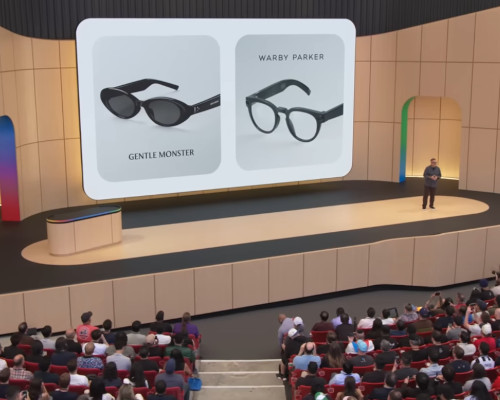 The tech giant's return to eyewear, backed by Warby Parker, Gentle Monster and Samsung, signals a new era for the frame market
More than a decade after the spectacular flop of Google Glass, the search giant is back in the frame, literally. At its Google I/O 2026 developer conference last week, Google unveiled intelligent eyewear powered by its Gemini AI assistant, and this time the company appears to have learned from its past mistakes. The result is a product that will be far harder for optical dispensers and industry players to ignore.
Developed in partnership with Samsung and Qualcomm on the Android XR platform, the new glasses are being positioned as everyday wearables rather than a niche tech curiosity. Crucially, Google has gone straight to the fashion world for credibility. First designs have been unveiled in collaboration with eyewear brands Gentle Monster and Warby Parker, set to launch as part of their full collections later this year.
The strategic decision to align with established eyewear names rather than launch a standalone Google-branded product is significant. It reflects a lesson bitterly learned with the original Google Glass: that wearable tech lives or dies on whether people actually want to put it on their face each morning.
Audio first, display to follow
The first devices to reach market will be audio glasses, arriving in the Northern Hemisphere's autumn of 2026. The second category of display glasses, which show information directly within the lenses, is also in development though no launch date has been confirmed for that variant.
The audio glasses feature speakers integrated into the temples and a discreet camera built into the frame. Users can activate Google's Gemini AI by voice command or by tapping the arm of the glasses. From there, they can ask questions about their surroundings, get turn-by-turn navigation based on where they're standing and which direction they're facing, manage calls and texts hands-free, snap photos and videos, receive real-time speech and text translation, and execute multi-step tasks through compatible apps.
The glasses will be compatible with both Android and iOS phones, a deliberate move to broaden the potential customer base well beyond the Android ecosystem.
What it means for optical retailers
For eyecare professionals and optical dispensers, the implications are worth thinking through carefully. Warby Parker, already a disruptive force in optical retail with its direct-to-consumer model and in-house eye exams, is now a hardware partner for one of the world's largest technology companies. That deepens an already vertically integrated player's reach into the wearable space.
The question for independent dispensers and optical chains alike is where prescription integration fits into this picture. Neither Google's announcement nor the available product details address whether the frames will be compatible with prescription lenses, a gap that represents both a challenge and an opportunity for the optical profession. If and when prescription-compatible versions arrive, the dispensing relationship could become a meaningful channel for this category of product.
A crowded field with serious momentum
Google is entering a segment that Meta and EssilorLuxottica have already been building, with Meta reporting more than 7 million pairs of Ray-Ban Meta smart glasses sold to date. Further competition is expected from Snap and, according to various reports, Apple. Amazon has also announced its own models in development.
The smart eyewear category, which looked like a fanciful experiment just a few years ago, is rapidly becoming a genuine product segment with mass-market ambitions. Google's entry, backed by the distribution muscle of established eyewear brands and the ubiquity of its AI platform, will only accelerate that trajectory.
Privacy questions resurface
As with competing products, the integrated camera capability is already raising questions about the risk of recording people without their knowledge or consent, a concern that regulators in multiple markets have been closely monitoring. For optical professionals advising patients on these products, privacy considerations may become part of the dispensing conversation.
The smart glasses race is on in earnest. For an industry built on the intersection of health, technology and style, it's a development worth watching closely.