


Free Visual Field Tool Launches for Australian Eye Clinicians
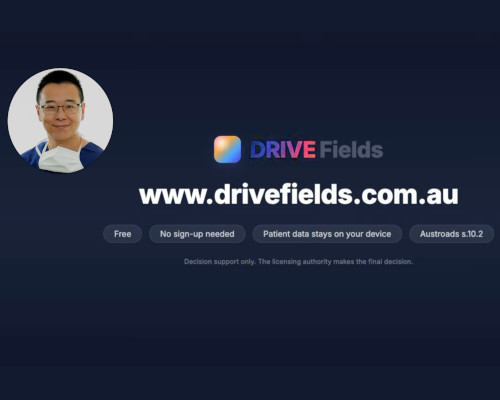 A Sydney ophthalmologist has released a free browser-based decision-support tool designed to help optometrists, ophthalmologists, and trainees apply the Assessing Fitness to Drive (AFTD) 2022 driving visual field criteria with greater consistency and confidence.
DRIVE Fields, developed by Dr Simon Chen FRANZCO of the Vision Eye Institute in Sydney, went live on 9 May 2026 and has already attracted users from across Australia. A Learning and CPD Centre, including a structured 60-minute self-directed CPD module, was added in the v0.4 release on 17 May 2026.
Filling a Gap in Everyday Clinical Practice
Driving visual field interpretation is a routine but technically demanding task. Clinicians must apply the AFTD rules around horizontal extent, central field defects, reliability thresholds, and licence class. The edge cases are easy to misjudge.
"Driving visual-field interpretation is one of those clinic tasks that looks simple until the AFTD edge cases matter," Dr Chen said of the motivation behind the project.
DRIVE Fields addresses this by walking clinicians through the fitness to drive assessment step by step, with the rule basis shown explicitly rather than hidden. Users mark missed points on an interactive Esterman grid, enter test details including licence class, state or territory, visual acuity, fixation monitoring, and false-positive rate, and the tool generates a printable summary or detailed report suitable for the clinical record.
The tool supports multiple device pathways including Humphrey standard and roving Esterman, Medmont M700/M900, Melbourne Rapid Fields (MRF 124-point layout), and Henson 9000 Group 1 and Group 2 layouts.
Privacy-First Architecture
In an era of heightened sensitivity around patient data, DRIVE Fields has been built with a clear privacy position: all assessments run entirely in the browser. After the initial page load, no further network calls are made during use. Patient details, missed points, reliability values, and assessment results are not uploaded to any server or stored in any case database.
"Every assessment runs entirely in your browser," the site states. "Patient details, missed points, reliability values, and test results are not uploaded to DRIVE Fields."
Only three anonymised convenience preferences, i.e. last selected state or territory, field layout, and printout source, are saved locally to streamline repeat visits.
CPD and Learning Centre
The v0.4 release added a structured Learning and CPD Centre aimed at trainees, practitioners new to driving assessments, and those seeking to consolidate their knowledge. It includes 24 teaching cases covering a range of field patterns from straightforward passes to complex borderline and high-risk scenarios, as well as clinical learning topics across Esterman testing fundamentals, device and printout interpretation, fixation monitoring, roving Esterman pathways, Austroads rule application, authority submission guidance by state and territory, and Medicare billing notes.
The centrepiece of the CPD Centre is a 60-minute guided learning module with cases, questions, reflection prompts, and a printable CPD Activity Completion Certificate.
Early Feedback from Peak Bodies
Dr Chen reports that the tool is already seeing clinical uptake nationally, with encouraging feedback from both optometry and ophthalmology colleagues. Clinicians connected with the RANZCO Visual Standards Committee, Glaucoma Australia, and Optometry Australia have also used the tool and provided positive early feedback, which Dr Chen described as particularly useful for review and refinement.
Scope and Limitations
DRIVE Fields is explicitly framed as decision support only. The tool produces AFTD-referenced assessment outputs, but the driver licensing authority retains the final licensing decision. Clinicians remain responsible for interpreting results in the context of the individual patient and the original visual field printout.
"The clinician remains responsible for the final assessment and any report sent to the licensing authority," the site states.
For borderline, monocular, commercial, or complex cases, DRIVE Fields returns a "manual review required" verdict rather than a calculated outcome, flagging that the clinician should assess directly against the printout and the AFTD criteria.
Free, and Intended to Stay That Way
Dr Chen has stated the tool will remain free indefinitely. "DRIVE Fields is free forever. There is no subscription, no premium tier, and no plan to introduce one," he writes. "If you want to support the work, share it with a colleague."
The project was built as a clinical contribution, not a commercial product, with the stated aim of reducing variability in driving visual field interpretation across Australian clinical practice.
DRIVE Fields is accessible via any modern browser at www.drivefields.com.au. A 90-second walkthrough video for first-time users is available on the site.