


AI Agents Are Reshaping Websites: What Eyecare Practices Need to Know
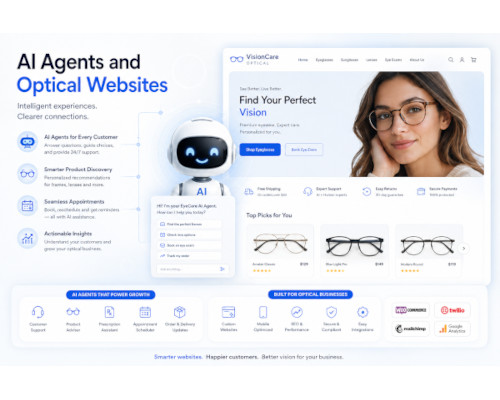 Google has outlined a future in which websites are built not only for people, but also for AI agents acting on their behalf, with accessibility, semantic structure and machine-readable actions becoming central to web design.
Speaking in a recent presentation, the company described the emerging “agentic era” as one in which users increasingly rely on AI systems to browse, compare, book and complete tasks online. For eyecare businesses, that shift could have implications for everything from appointment booking and product discovery to practice information and patient communications.
A key message from the talk was that sites which are already well structured for human users will also be better suited to AI agents. Clear navigation, properly labelled buttons, semantic HTML and accessible design were all highlighted as essential foundations.
Accessibility becomes strategic
The presentation placed strong emphasis on accessibility, noting that agents often interpret websites through the same cues that assistive technologies use, including the DOM and accessibility tree. In practice, that means practices and suppliers that rely on visually complex interfaces, hidden controls or non-standard interactions may find their sites harder for AI systems to understand.
For eyecare businesses, this is not just a technical issue. Practices with online booking, product catalogues, educational content or patient forms may increasingly need those functions to be easy for automated agents to read and use.
The broader takeaway is that accessibility is becoming more than a compliance obligation. It is now also a competitive advantage in an environment where digital assistants may act as the first point of contact between a patient and a business.
New tools for agents
The presentation also introduced the idea of WebMCP, a proposed standard for exposing structured tools directly to agents. Rather than forcing an AI system to infer what a website can do from its layout, WebMCP would let sites declare actions such as search, book, submit or retrieve in a more explicit way.
The concept is designed to make browser-based agents more reliable, especially for tasks that require precision. That could matter for practices that want AI systems to interact with appointment systems, eyewear ordering flows or service requests without ambiguity.
The proposed standard was presented as distinct from traditional MCP approaches, with WebMCP tied to the current browser session rather than a persistent server connection. The goal is to make the interaction more immediate and more tightly aligned with what is happening on screen.
What it means for eyecare
For eyecare professionals, the practical message is straightforward: websites should be built as clearly and semantically as possible. That includes using real buttons instead of clickable divs, meaningful labels for form fields, and consistent page structures that help both people and machines understand what is available.
Practices and vendors that invest in clean digital architecture may be better positioned as AI agents become a more common part of patient and consumer behaviour. In time, that could influence how patients find a practice, book an appointment or compare services online.
The presentation also suggested that browser tools and developer diagnostics will increasingly include checks for agent readiness, making this an area likely to gain momentum quickly.
Industry takeaway
For the eyecare sector, the rise of agentic browsing points to a simple but important conclusion: the best websites of the next few years will be the ones that are already usable, accessible and logically structured today.
That means the fundamentals still matter: clear content, intuitive navigation and robust accessibility. The difference is that these basics are no longer just about user experience. They are becoming part of how digital systems will understand and use the web.