
Two AI Eyewear Launches in One Week Put Fresh Pressure on the Optical Channel
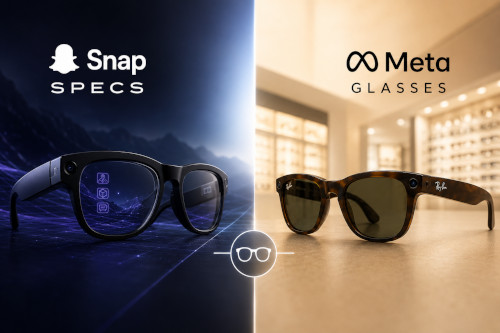 Snap's US$2,195 SPECS and the new sub-US$300 Meta Glasses collection signal a widening gap between premium AR and mass-market smart eyewear with prescription fulfilment caught in the middle.
In the space of a week, two of the biggest players in smart eyewear staked out opposite ends of the market, and both moves have direct implications for practices fitting glasses every day.
On 16 June, Snap Inc. unveiled SPECS, a standalone augmented reality device built into see-through glasses, priced at US$2,195 with pre-orders open now and shipping expected this northern autumn in the US, UK and France. A week later, on 23 June, EssilorLuxottica and Meta announced a new, more affordable Meta Glasses collection starting at US$299, aimed squarely at "more price-sensitive consumers," according to EssilorLuxottica chairman and CEO Francesco Milleri.
Snap goes all-in on spatial computing
SPECS is positioned as a category of its own, more capable than existing AI glasses but lighter and more wearable than full AR headsets, with no external puck or tether required. Built from Swiss TR90 polymer, the frames come in two sizes (132g and 136g) and use a proprietary liquid-crystal-on-silicon display with a 51-degree field of view, which Snap compares to a 24-inch desktop monitor or a 115-inch home cinema screen at a 3-metre viewing distance.
For dispensing opticians, the relevant detail is that SPECS use removable prescription inserts, allowing the device to support "a wide range of prescriptions" without building Rx directly into the AR optics. The lenses are also electrochromic, shifting from clear to tinted in around 10 seconds, technology Snap says is drawn from aircraft window dimming systems.
Two Snapdragon processors handle computer vision and the Lens (app) layer respectively, delivering what Snap describes as 7-millisecond motion-to-photon latency. Battery life is rated at up to four hours of mixed use, extending to 20 hours with the bundled charging case.
Snap also used the launch to expand its developer ecosystem, introducing agentic Lens-building tools in Lens Studio, rolling out via Claude Code, Codex and Cursor, alongside a new spatial benchmark for AI models and a migration tool for porting existing AR projects to the platform.
EssilorLuxottica and Meta chase volume, not novelty
The Meta Glasses announcement takes a very different path. Rather than pushing new hardware capability, EssilorLuxottica and Meta are extending their existing AI glasses stack, Ray-Ban Meta, Oakley Meta, Meta Ray-Ban Display and the prescription-focused Ray-Ban Meta Optics, into a new, lower-cost, jointly branded line.
The collection comprises three Rx-able shapes (rectangle, square and oval), offered with clear, sun and Transitions lens options. It has launched across Meta.com in the US, Canada, UK, France, Italy, Germany and Spain, and through optical retail partners including LensCrafters and Sunglass Hut in the US, with further markets and retailers to follow later this year. Meta CEO Mark Zuckerberg framed the move as making glasses "a main way people access personal superintelligence," with the explicit goal of broadening adoption beyond early premium buyers.
What it means for the channel
For eyecare professionals, the contrast is less about specs-sheet bragging rights and more about distribution and dispensing workload. Meta's strategy keeps prescription fulfilment running through familiar retail and lab channels EssilorLuxottica already controls, using established lens technologies such as Transitions. Snap, by contrast, is selling direct via SPECS.com with removable Rx inserts, a model closer to ski-goggle or industrial-eyewear insert fitting than traditional spectacle dispensing, and one that may sit outside existing lab workflows altogether.
Pricing also points to diverging strategies: Snap is chasing a premium, developer- and creator-led audience willing to pay AR-headset-adjacent prices, while EssilorLuxottica and Meta are betting that sub-US$300 pricing, closer to a pair of premium sunglasses, is what finally pushes smart eyewear into mainstream optical retail.
Neither company has yet detailed local Australian availability or pricing, though both releases note further markets are expected later in the year.