


Chinese-Led Team Builds Light-Sensing Chip That Mimics the Eye's Own Glare Response
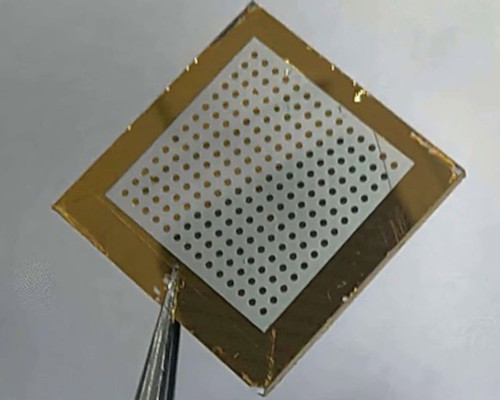 A device the size of a sesame seed could reshape how machines "see" and offers a fresh reference point for anyone thinking about the future of bionic vision.
Researchers in China and the United States have built a light-sensitive chip that automatically adjusts its own sensitivity in response to glare and dim conditions, without any of the circuitry or software that current machine-vision systems rely on, a feat that brings artificial eyes a step closer to replicating one of the human eye's most underrated talents.
The work, published this month in Nature Communications, was led by materials scientist Jia Zhu at the University of Electronic Science and Technology of China, working with colleagues at Penn State University and other institutions. The team describes a "photomemristor", a memory-resistor that responds to both light and electrical signals, built from a stacked material called TiO₂/PEDOT:PSS. The finished device is roughly half a millimetre across.
Why it matters for eyecare
For clinicians, the appeal isn't the chip itself so much as what it's chasing: the human eye's extraordinary dynamic range. The retina can process scenes spanning more than 160 decibels of brightness enough to make sense of a darkened cinema and an oncoming headlight within the same field of view. Most camera sensors and existing "artificial eye" prototypes fall well short of this, and typically need bulky auxiliary circuits or heavy computational correction to cope with mixed lighting.
The new chip gets around this using chemistry rather than code. Light striking the TiO₂ layer generates a small photocurrent, which heats the underlying PEDOT:PSS polymer. That warming shifts a delicate equilibrium between water molecules binding to and leaving the polymer's surface, which in turn changes how many charge carriers are available and therefore how conductive, and how light-sensitive, the material is. Under bright light, water is driven off, sensitivity drops sharply, and the current can even fall below the device's baseline "dark" reading, echoing the way a pupil constricts. Under dim light, water re-adsorbs, sensitivity rises, and weak signals get amplified.
The numbers
When wired into an array and paired with a basic artificial neural network, the system reportedly achieved 91.3% accuracy recognising simple letter patterns under deliberately mixed lighting, a moderately lit shape set against both a dark background and a bright glare source, designed to mimic a driver spotting a pedestrian near an oncoming vehicle's high beams. The researchers say the approach removes the need for the extra image-processing steps that comparable adaptive sensors have required to correct for lighting extremes.
A step, not a product
It's worth being clear about scope: this is a single-pixel-style photomemristor and a 4×4 test array, not an implantable or wearable device, and there is no clinical pathway attached to it. The authors themselves frame the near-term applications as autonomous vehicles, humanoid robots and outdoor monitoring equipment, with a bionic artificial eye prototype flagged as a longer-term goal requiring further work on packaging, signal readout and control systems.
Even so, the underlying principle, building light adaptation into the material itself, rather than bolting it on with electronics or software, is the kind of biomimetic approach that regularly finds its way from machine-vision labs into retinal prosthetics and low-vision aid research. Practices with an interest in visual neuroscience or emerging assistive technology may want to keep half an eye on where this line of research heads next, particularly as the group has flagged plans to test whether the same water-adsorption mechanism can be generalised across other oxide/polymer material combinations.
The bottom line
No device is heading into a consulting room any time soon. But the study adds a genuinely new physical mechanism, reversible water uptake in a conducting polymer, to the small toolkit of strategies engineers are using to try to match the eye's light-handling ability, and it's a reminder that some of the most eye-relevant innovation right now is happening in materials science labs, not ophthalmology departments.
(image courtesy: Jia Zhu)