


Light-activated Eye Drops Restore Sight in Blind Mice
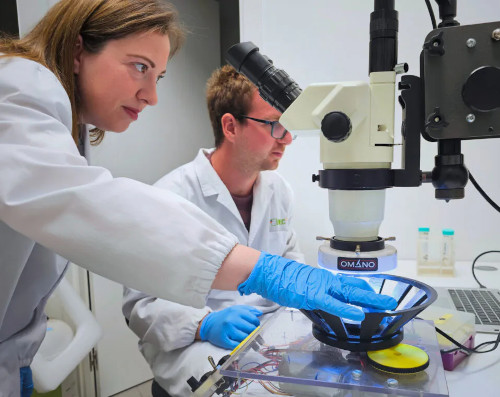 Spanish researchers report a new class of photoswitchable small-molecule drugs that reactivate vision in mouse models of AMD and retinitis pigmentosa without gene therapy or implants.
A European research consortium has developed a family of light-sensitive drug compounds that restored functional vision in blind mice and zebrafish, in results published this month in the Journal of the American Chemical Society (JACS) and announced by the Institute for Bioengineering of Catalonia (IBEC) on 22 July.
The compounds, dubbed "prosthe6," belong to a growing drug class known as photopharmacology, in which a drug's activity can be switched on and off reversibly by exposure to light. Rather than targeting the eye's damaged photoreceptors directly, prosthe6 compounds act one step downstream, on ON-bipolar cells, the retinal neurons that normally receive signals from rods and cones and remain largely intact even in advanced degenerative disease.
For eyecare professionals, the study is notable less for its distance from the clinic, the work is still preclinical, than for its target and delivery profile: a disease-agnostic, drug-based approach that the authors say could eventually be administered as eye drops rather than through surgery, implants or gene therapy.
The clinical problem
Photoreceptor-driven blinding diseases such as geographic atrophy secondary to dry age-related macular degeneration (AMD) and retinitis pigmentosa (RP) affect an estimated 200 million people worldwide and carry a global economic burden of more than US$400 billion annually in healthcare costs and lost productivity, according to the researchers.
Current options remain limited. Gene therapy is effective only for a narrow subset of RP patients with specific mutations, while electronic retinal prostheses are invasive, expensive, and require extensive rehabilitation to interpret prosthetic vision. Optogenetic approaches and light-responsive drugs have entered clinical trials more recently, but achieving high-quality vision under ordinary ambient lighting has proven difficult.
How the molecules work
Prosthe6 compounds target the metabotropic glutamate 6 (mGlu6) receptor, found exclusively on the dendrites of ON-bipolar cells, immediately downstream of the photoreceptor synapse. In a healthy retina, photoreceptors release glutamate in the dark to keep this receptor active, and reduce that release under light, a signal that mGlu6-expressing bipolar cells relay onward to the rest of the visual circuit.
The research team engineered small, water-soluble molecules that mimic this pattern directly: they activate mGlu6 in darkness and switch off under ordinary white or blue light, without requiring any glutamate input from degenerated photoreceptors. Because the compounds act upstream in the circuit, at what the authors call a "privileged" cellular location, the intention is to preserve the retina's native image-processing functions, including motion, contrast and orientation coding, that are lost or degraded by therapies acting further downstream.
Two lead candidates, prosthe6-12 and prosthe6-15, showed the strongest combination of potency and photoswitching efficiency, with nanomolar potency in vitro and reactivation half-lives in the dark as fast as roughly one to four seconds and as fast as one millisecond for a related analogue, prosthe6-14.
What the animal studies showed
In blinded zebrafish larvae, a single drop of prosthe6-12 or prosthe6-15 applied directly to the animal restored the optokinetic reflex, the reflexive eye-tracking saccade used to measure visual acuity, within minutes, reaching up to 75 percent of the response seen in sighted larvae.
In mouse models of both geographic atrophy and RP, the compounds restored innate light-avoidance behaviour: healthy mice naturally seek out dark spaces, a preference blind mice lose. After treatment, previously blind mice again showed a clear preference for darkness under illumination levels comparable to an overcast day or typical indoor lighting, a result the team notes was achieved without any training of the animals. The effect held whether the drug was delivered by intravitreal injection or, notably, as topical eye drops, and the researchers confirmed the mechanism was mGlu6-dependent by blocking the effect with a selective receptor agonist.
Pharmacokinetic studies in rabbits found the unformulated compound was detectable in the retina for six to twelve hours after topical or intravitreal dosing respectively, with no detectable systemic exposure in plasma, an early signal for ocular safety. The authors also report a favourable predicted toxicity profile relative to comparator compounds, and that prosthe6-12 and -15 interacted with only one and three off-targets respectively in a panel of 87 receptors, ion channels and transporters screened for safety.
The team benchmarked prosthe6-12 against BENAQ, a photoswitchable ion-channel blocker currently in a phase 1/2 human trial for RP; in their zebrafish assay, BENAQ did not produce a significant behavioural recovery at its reported working concentration and caused toxicity at higher doses, whereas prosthe6-12 was effective at concentrations more than 100-fold lower.
What the researchers say
"These molecules do not cure blindness, because they do not address the cause of photoreceptor degeneration," said Pau Gorostiza, ICREA research professor at IBEC and co-leader of the study. He said the approach nonetheless offers "a realistic possibility of restoring high-quality vision with drugs, non-invasively, reversibly," independent of the specific retinal disorder or genetic mutation involved.
Co-author Rosalba Sortino, a postdoctoral researcher in Gorostiza's group, said the goal was to reactivate the retinal circuit "at the same level" as the lost photoreceptor cells, rather than bypassing that processing altogether.
Study co-leader Pedro de la Villa, of the University of Alcalá, noted that although photoreceptors are lost in degenerative disease, much of the underlying bipolar cell circuitry remains intact but inactive which he described as a significant therapeutic opportunity.
Context and next steps
The paper is the second photopharmacological approach to reach in vivo proof of concept for vision restoration in recent months, following the first human trial of a different photoswitchable drug, BENAQ, which targets HCN ion channels rather than mGlu6 receptors. The authors argue their upstream, receptor-specific targeting strategy may offer better-preserved visual processing than approaches acting on more broadly distributed ion channels.
The prosthe6 technology is patent-protected, and the consortium which also includes the University of Barcelona, the Institute Ramón y Cajal of Health Research (IRYCIS), the Autonomous University of Barcelona, the Institut de Química Avançada de Catalunya (IQAC-CSIC) and the Fundació Eduard Soler, is now working through a spin-off company in formation, Eyelumina, to raise funding for further safety and formulation work ahead of any clinical trial application.
Gorostiza was candid about the road ahead: "Turning this into a therapy is a long and laborious process." For now, the results are confined to zebrafish and mouse models, and the compounds have not yet been tested in humans or in larger animal eyes, where drug exposure to the retina may differ substantially from rodent models.