
Homing Pigeons Caught "Wobbling" Their Eyes Mid-Flight, in Finding With Implications for Vision Science
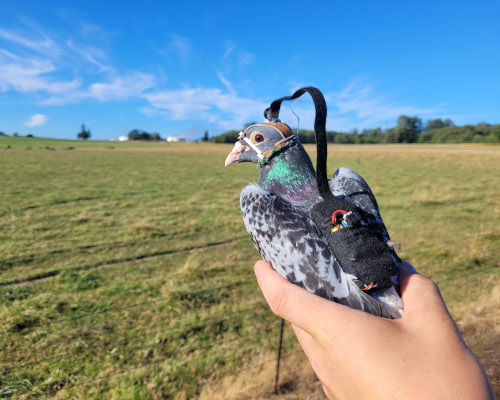 Canadian researchers rig pigeons with miniature cameras and hand-sewn falconry hoods to capture a behaviour long assumed not to exist and one that may hold lessons for both robotic vision and how we understand the visual system in motion.
For decades, the working assumption among vision scientists was straightforward: birds with laterally placed eyes, like pigeons, hold their eyes still during flight so that the visual motion sweeping across the retina, known as optic flow, remains a clean, undistorted signal for navigation. A new study out of the University of British Columbia suggests that assumption was wrong.
Using a custom-built onboard camera system weighing just 27 grams, complete with hand-sewn falconry-style hoods and miniature backpacks, researchers led by Dr Anthony Lapsansky and Dr Doug Altshuler tracked eye movements in homing pigeons (Columba livia domestica) released several kilometres from their home loft. Rather than remaining fixed, the pigeons' eyes made slow, divergent movements that closely matched the speed and direction of the optic flow generated by forward flight.
A reflex working with motion, not just against it
Optic flow is central to how moving animals judge their speed, heading and proximity to objects. But it creates a problem: reflexive eye, head and body movements typically act to minimise optic flow and keep the retinal image stable, since image stability is critical for normal visual processing. If pigeons were simply cancelling out that motion by holding their eyes rigid, the question becomes how they extract useful navigational information from the scene at all.
The study, published in Current Biology, found the opposite of pure stabilisation. In free flight, pigeons made slow, divergent, outward-turning, eye movements consistent with an optokinetic response, tracking the horizon as it moved past in the lateral visual field. The same divergent pattern was reproduced in head-restrained birds shown computer-generated visual stimuli simulating self-translation through space, reinforcing that the behaviour is a genuine visuomotor response rather than an incidental head-stabilisation artefact.
Landing produced a strikingly different pattern. As pigeons approached a perch, their eyes made large, convergent movements, turning inward, toward each other, of a magnitude sufficient to support stereopsis, the depth perception that comes from comparing slightly offset views from each eye. Binocular convergence of this kind has previously been documented in only a handful of birds, mostly raptors with forward-facing eyes adapted for hunting.
Falconry skills repurposed for the lab
The methodology is as notable as the result. Dr Lapsansky, a former falconer, adapted falconry hood-making techniques to hold the miniature camera rig steady on each bird's head. The full system, a small onboard computer roughly half the size of a credit card, a modified commercial camera, a motion and orientation sensor, and wiring, was fitted to two pigeons at a time within a larger flock, with dummy packs used as controls. Birds were released on a familiar route and tracked home by vehicle to retrieve the footage.
Why it matters beyond ornithology
For an eyecare and vision-science readership, the finding adds to a growing body of comparative work on how oculomotor strategies are tuned to the specific perceptual demands of a task, here, distinguishing sustained forward transit from the terminal, high-precision demands of landing. The pigeon data suggest a functional split between an optokinetic strategy that extracts extra detail from a moving scene during flight, and a vergence-driven strategy that switches on to support depth judgement only when depth judgement is actually needed, approach and landing.
The researchers also point to applications in autonomous flight systems. Most drones and flight robots rely on a fixed camera, using the resulting visual motion to infer speed, heading and collision risk. The pigeon findings indicate that biological vision systems get more out of a scene by actively moving the "camera" itself, rather than holding it rigid, a strategy the authors suggest could inform more capable, animal-like navigation systems for robotics.