
AI Model That "Understands" Reading, Not Just Eye Movement, Could Reshape Low-Vision Tools and Smart Eyewear
 New Nature Human Behaviour study builds the most accurate model yet of human reading, with implications for AR glasses, dyslexia support and personalised text
A new artificial intelligence model that predicts not just where a reader's eyes will land, but why, has been unveiled by researchers at Finland's Aalto University in collaboration with the Hong Kong University of Science and Technology, City University of Hong Kong and the National University of Singapore. The findings should be on the radar of anyone working in optometry, low-vision rehabilitation or ophthalmic technology.
Published this month in Nature Human Behaviour, the study describes what its authors call the most accurate computational model yet of human reading behaviour. Unlike earlier eye-tracking models, which were trained on large datasets pairing text with gaze data and simply learned to mimic recorded eye movements, the new system is built on reinforcement learning, the same branch of AI used in robotics, and simulates the underlying psychological strategy readers use to extract meaning from text.
Reading as a budgeting problem
The model is grounded in a concept the researchers call "resource rationality": the idea that a reader is constantly deciding, in real time, where to look next in order to maximise comprehension within a limited time budget. Those decisions happen at three levels: word, sentence and whole-text. They are shaped by variables including a reader's language proficiency, working memory capacity, and the speed of their eyes and vision.
"Reading feels effortless, but your brain is constantly deciding where to look, what to skip, and when to backtrack, spending attention like a budget to maximise understanding," said co-author Professor Shengdong Zhao, of City University of Hong Kong.
Because those reader characteristics were built into the model as adjustable parameters, the researchers could simulate different reader profiles. A fast reader with strong memory, for instance, tends to move briskly through paragraphs, while a reader with weaker memory recall is more likely to loop back and re-read earlier passages, patterns the model reproduced when tested against real human eye-tracking data.
Why it matters for eyecare professionals
For the vision-care sector, the significance lies less in the eye-tracking mechanics, which have been studied for decades, and more in what the model does with that gaze data: it builds a genuine internal representation of what has been understood, and can direct the simulated "gaze" back to a word or clause when comprehension is incomplete. That distinction between mimicking eye movement and modelling comprehension is what lead author Professor Antti Oulasvirta, of Aalto University, says sets the work apart.
"For the first time we've used AI methods to understand, not just mimic, how people read," Oulasvirta said.
The research team points to two near-term applications with direct relevance to the optical and low-vision fields:
- Adaptive augmented reality displays. The model could inform how text is paced and laid out on smart glasses and AR headsets, adjusting to a wearer's reading speed and situational demands. For example, presenting information to a driver in a way that supports comprehension without becoming a visual distraction.
- Personalised text and reading-support tools. Because the model can flag where and why comprehension breaks down for a given reader profile, it opens the door to software that reformats dense material, the researchers cite convoluted legal writing as an example, into versions tailored to an individual's reading capability, rather than a one-size-fits-all layout.
Oulasvirta noted that despite reading being a near-universal daily activity, text has historically been produced for mass audiences rather than tailored to the individual. "Now we are in a position to change that," he said.
Next stop: dyslexia and low vision
The research team's stated next step is to test how the model can support people with dyslexia and low language proficiency: a population that overlaps significantly with patients seen by optometrists and low-vision specialists for reading rehabilitation. If the model can reliably flag the specific points in a text where a given reader's attention and comprehension strategy breaks down, it could eventually inform the design of low-vision reading aids, magnification software, or myopia-management apps that adapt pacing and layout to an individual's visual and cognitive profile, rather than relying on generic font and contrast adjustments alone.
For practices already exploring digital vision therapy, dyslexia screening or smart-glasses dispensing, the study is an early signal that the next generation of reading-support technology may be built on a far more granular understanding of how a given patient's eyes and brain actually process a page, not just how fast they can read a line of text on a chart.
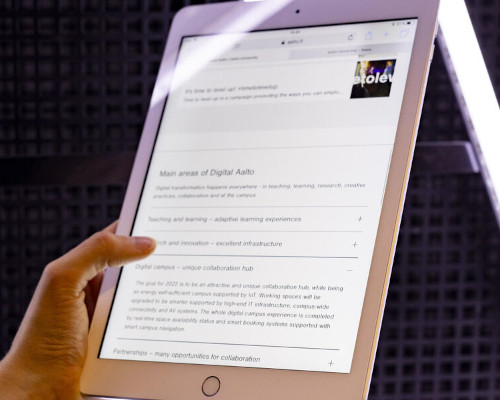
(Image credit: Kalle Kataila / Aalto University)