


World-First AI-Guided Brain Surgery Saves UK Patient's Sight
 A London hospital has become the first in the world to use real-time artificial intelligence during live neurosurgery, in a case that protected a patient's vision from a tumour pressing on his optic pathways. For eyecare professionals, it's an early signal of where surgical AI is headed, and vision preservation is right at the centre of it.
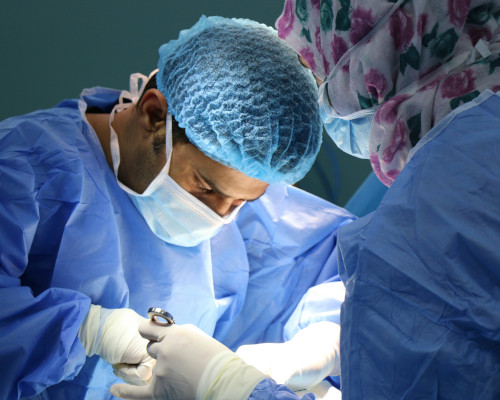
Surgeons at the National Hospital for Neurology and Neurosurgery (NHNN), part of University College London Hospitals (UCLH), have carried out what is being described as the world's first AI-assisted neurosurgery performed in real time, successfully removing a brain tumour while protecting the patient's eyesight.
The patient, 48-year-old Bedfordshire customer service manager Rhys Hibbert, had a tumour that, left untreated, threatened to cause blindness. During the operation, an AI system developed at the UCL Hawkes Institute analysed the live surgical video feed as the procedure unfolded, rather than relying solely on pre-operative scans, helping the surgical team identify critical structures at the skull base in real time.
A Crowded, High-Stakes Anatomical Space
The surgery targeted the pituitary region, where the pituitary gland, major blood vessels and the nerves controlling vision sit within millimetres of each other. A slip of even a millimetre in this territory can cause blindness, stroke or death. The AI system was designed to flag risk zones for the surgical team as they worked to remove as much of the tumour as could be done safely, and its developers say it also has the potential to track surgical instruments and how they interact with tissue.
The procedure was led by consultant neurosurgeon Professor Hani Marcus of NHNN, UCLH and UCL Queen Square Institute of Neurology, with surgical resident Danyal Khan. Marcus said the milestone reflected years of work by the trial team and described it as an important first step in using UK-developed AI to reduce risk in delicate procedures.
The AI's technical lead, Dr Sophia Bano of UCL Computer Science and the UCL Hawkes Institute, said the system had been trained on hundreds of annotated endoscopic pituitary surgery videos, exposing it to a breadth of surgical scenarios that would take a human surgeon years to encounter, so it could recognise critical anatomy, instruments and tissue interactions as the operation progressed.
Why Eyecare Professionals Should Pay Attention
While this is a neurosurgical trial rather than an ophthalmic one, the target of the intervention is unmistakably visual: the tumour was pressing on structures governing sight, and vision preservation was the clinical win being reported. It's a useful reminder for optometrists and ophthalmologists of how closely eye health intersects with neurosurgical and skull-base practice, particularly for patients presenting with visual field loss or other symptoms linked to pituitary or parasellar tumours.
It's also a preview of a broader trend. Real-time, video-based AI guidance during live surgery, as opposed to AI applied only to pre-op imaging, is a genuine technical step up, and researchers globally are already exploring related applications, including AI that highlights tumour tissue on intraoperative ultrasound or flags the likely location of critical structures mid-procedure. The same underlying approach, computer vision trained on large surgical video datasets, providing real-time overlays and confidence signals to the operating surgeon, is the kind of tool likely to migrate into ophthalmic surgery over time, from cataract and vitreoretinal procedures to oculoplastic and neuro-ophthalmic work.
The trial, funded by the UK's National Institute for Health and Care Research (NIHR) and Google, with support from the NIHR Biomedical Research Centre at UCLH, the Royal College of Surgeons, the Engineering and Physical Sciences Research Council and Wellcome, is ongoing. Researchers say it will report on the feasibility, safety and clinical outcomes of the approach as more patients are treated.
UK Health Innovation Minister James Frith welcomed the case, framing it as an example of publicly funded research translating into direct patient benefit, while NIHR Scientific Director for Innovation Professor Mike Lewis said the work showed how investment in digital health technology could deliver practical tools for the operating theatre.
For now, the technology remains confined to a UK-based clinical trial in neurosurgery. But the underlying question it's testing, whether AI can meaningfully and safely assist a surgeon's decision-making in real time, is one that eyecare-adjacent surgical disciplines will be watching with interest as similar systems make their way toward regulatory approval and, eventually, broader clinical use.
Further detail on the trial has been published as a preprint on medRxiv.