


RMIT's Neuromorphic 'Bionic Eye' Prototype Marks Major Step Toward Smarter, Low-Energy Vision Restoration
A new atom-thin semiconductor prototype that mimics the human eye’s ability to sense, remember, and process visual data locally could one day revolutionise retinal prostheses, though clinical applications remain years away.
Australian researchers have unveiled a working neuromorphic vision prototype that could lay the foundational technology for the next generation of “smart” bionic eyes, dramatically reducing the energy and data bottlenecks that currently limit retinal implants.
Developed by a team at RMIT University’s Centre for Opto-electronic Materials and Sensors (COMAS), the early-stage innovation combines visual sensing, memory, and information processing within a single system.
For eyecare professionals, the breakthrough is significant. Current bionic vision systems and retinal prostheses often rely on bulky external hardware, including cameras and processing units, which shuttle massive amounts of data to the implant. This constant data transfer is highly energy-intensive and limits the resolution and practicality of the devices.
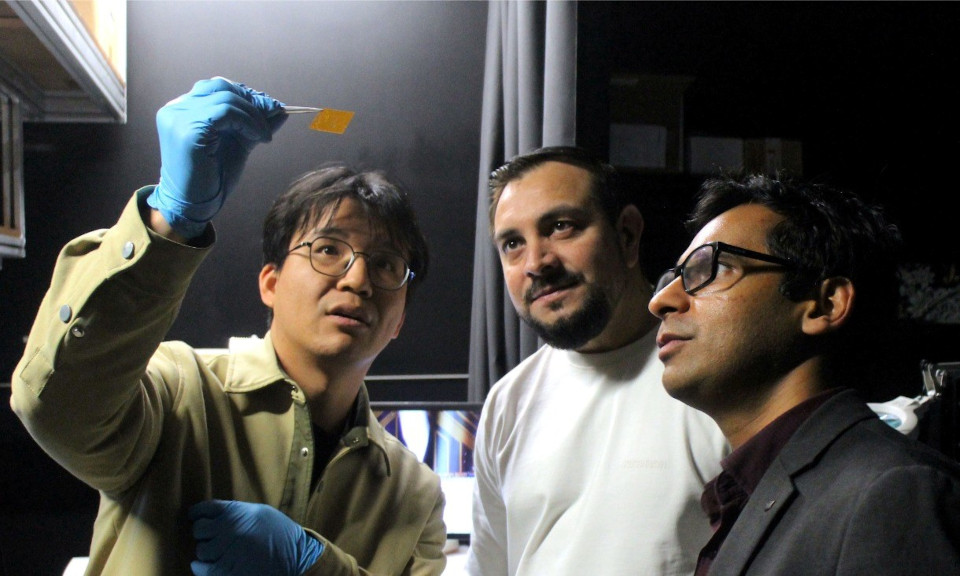 RMIT researchers Professor Sumeet Walia (right), Dr Taimur Ahmed (centre) and a colleague inspect the neuromorphic vision prototype during testing. Photo Credit: RMIT University
The RMIT prototype tackles this by mimicking the biological efficiency of the human visual system. Built using an atom-thin semiconductor material called molybdenum disulfide (MoS₂), the core technology is housed on a 2cm x 2cm chip. In laboratory testing, the system has successfully been trained to recognise patterns, numbers, shapes, and movement, processing and storing that information locally at the point of capture.
“Nature has already solved many of the challenges we’re trying to address in electronics,” said Professor Sumeet Walia, who leads the research at RMIT. “The human eye and brain work together incredibly efficiently, processing vast amounts of information using remarkably little energy. Our research is helping lay the foundations for technologies that work in a more similar way.”
Dr Taimur Ahmed, a co-researcher and expert in neuromorphic vision devices at RMIT, emphasised that the prototype represents a paradigm shift from conventional imaging.
“This is not just a sensor that captures information; it’s a sensor that can also process information,” Dr Ahmed said. “Rather than constantly moving data between separate memory and processing units, much of that work happens much closer to where the information is generated, closely mimicking the way biological vision works.”
A cleaner path to medical-grade manufacturing
Beyond the architectural design, the RMIT team has also solved a critical manufacturing hurdle. They developed a cleaner, water-based fabrication process to transfer the atom-thin semiconductors and electrodes. This lithography-free method produces significantly fewer defects than conventional techniques, resulting in devices with substantially improved electrical and light-sensing performance, a crucial prerequisite for any future biocompatible medical implant.
RMIT has filed an international patent application under the Patent Cooperation Treaty (PCT) for the invention, signalling strong commercialisation intent. The underlying research has been peer-reviewed and published in ACS Applied Materials and Interfaces and Advanced Materials Technologies.
What this means for eyecare professionals
While the researchers are careful to note that practical clinical applications are still years away, the trajectory of this technology is highly relevant to ophthalmologists, optometrists, and low-vision specialists managing patients with profound retinal degeneration, such as retinitis pigmentosa or advanced age-related macular degeneration (AMD).
If successfully scaled, neuromorphic bionic eyes could eventually offer:
- Reduced hardware burden: Less reliance on external processing units, leading to more cosmetically acceptable and practical devices for patients.
- Lower power consumption: Extended battery life and reduced heat generation, which are critical safety and usability factors for implanted medical devices.
- Faster visual processing: Localised data filtering could allow for more rapid interpretation of dynamic environments, improving patient mobility and safety.
“This work combines advanced materials, engineering, and artificial intelligence to address one of the defining challenges of our time: creating intelligent systems that are both powerful and sustainable,” Prof Walia added.
For the Australian eyecare sector, the development reinforces the nation’s strong footprint in vision science and bionic research, building on the legacy of initiatives like Bionic Vision Australia.
While practitioners should not expect to be prescribing or managing these devices in the immediate future, the RMIT prototype serves as a powerful reminder that the frontier of vision restoration is moving toward smarter, more biologically integrated solutions.